Barcode vs. RFID vs. QR Code: Comparing Physical Asset Tracking Methods
2024-11-30
tony
Efficient physical asset management has a direct impact on productivity. Barcodes, RFID, and QR codes are the main technologies used for asset tracking today. In this post, we compare the pros and cons of all three.
1. Barcodes: The Economical Starting Point
Barcodes are the oldest and most widely used method of asset management. They are best suited to small offices or simple asset tracking.
Pros
Low production cost: Low upfront costs keep the burden on your budget light.
Universal compatibility: Easily read by almost any scanner.
Cons
Limited data storage: Can only store simple numbers or text.
Barcode readers required: Without a barcode reader, you can't see an asset's information, and the readers themselves need to be maintained.
Barcode scanning with a handheld reader
2. RFID: Built for Large-Scale Management
RFID is a powerful technology for managing assets at scale and is mainly used in warehouses and on production lines.
Pros
Scan many assets at once: Quickly reads large numbers of assets wirelessly, without needing a direct line of sight to each tag.
Stores more data: Tags can hold more information.
Cons
High upfront cost: Tags and readers are expensive.
Interference around metal: Accuracy can drop on metal surfaces.
RFID tags and reader
3. QR Codes: The Right Balance of Flexibility and Cost
QR codes are an innovative asset management solution that delivers both affordability and flexibility. Because they can be scanned easily with any smartphone, anyone can use them.
Pros
Stores many types of data: Can hold a wide range of information, including text, URLs, and images.
Low production cost: As inexpensive as barcodes, but with more capabilities.
High damage tolerance: Thanks to built-in error correction, codes can still be scanned even when partially damaged.
Cons
Limited long-range scanning: Each code must be scanned individually, which makes QR codes a poor fit for large-scale real-time tracking. However, when every asset needs to be checked in person, this actually becomes an advantage.
Scanning a QR code with a smartphone
Why a QR Code-Based Solution Is the Best Fit
QR codes combine affordability, flexibility, and accessibility, making them a perfect fit for today's smartphone-centric workplace.
Use your smartphone Scan a QR code to check an asset's status in real time, with no extra equipment.
Unified data management Connect to the cloud to manage everything from physical assets to digital assets in one place.
Room to grow Easily store and access data such as asset condition, location, and usage history.
What Makes SELLEASE's QR Code-Based Physical Asset Management Different
Our QR code solution goes beyond a simple asset management tool and stands out as a smart asset management platform.
Intuitive UI/UX: An interface and Dashboard that even first-time users can pick up easily.
Real-time cloud integration: Update and check asset data anytime, anywhere.
High efficiency for the cost: Manage all of your company's physical assets at a reasonable cost.
Ongoing support and updates: Regular updates that reflect the latest technologies and trends.
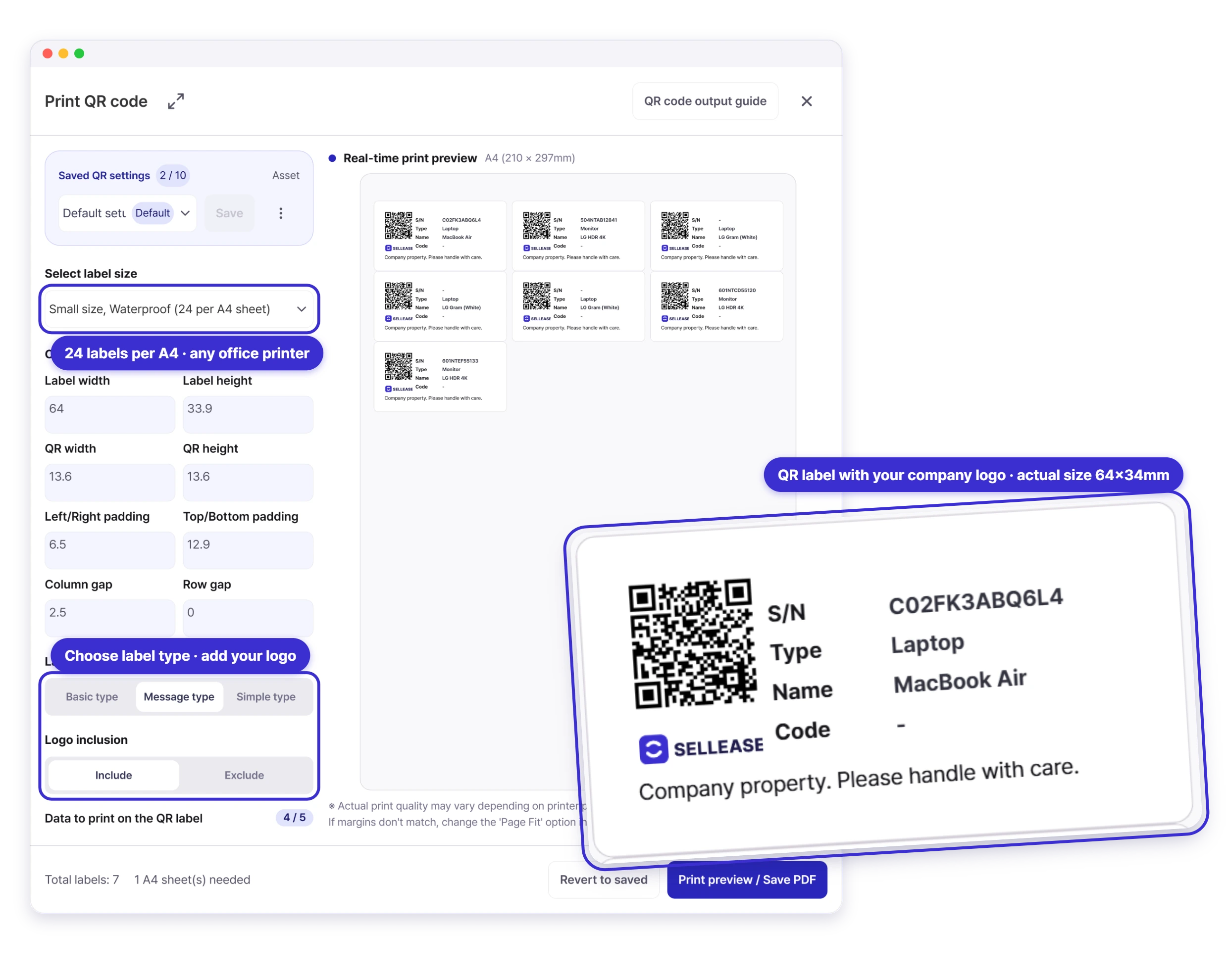
Easy QR code printing: Print on A4 label sheets with 12 labels per page and attach them to your assets right away.
QR code label print preview
Conclusion: It's Time to Manage Physical Assets with QR Codes!
QR code-based physical asset management is the best choice for boosting productivity and maximizing management efficiency. In particular, our QR code solution is an affordable, highly accessible, unified management tool that sets a new standard for asset management.
Switch to a QR code-based asset management solution today! You can find more details inside the service.